Bob: AI-Powered Raspberry Pi Rover
Published: July 27, 2026
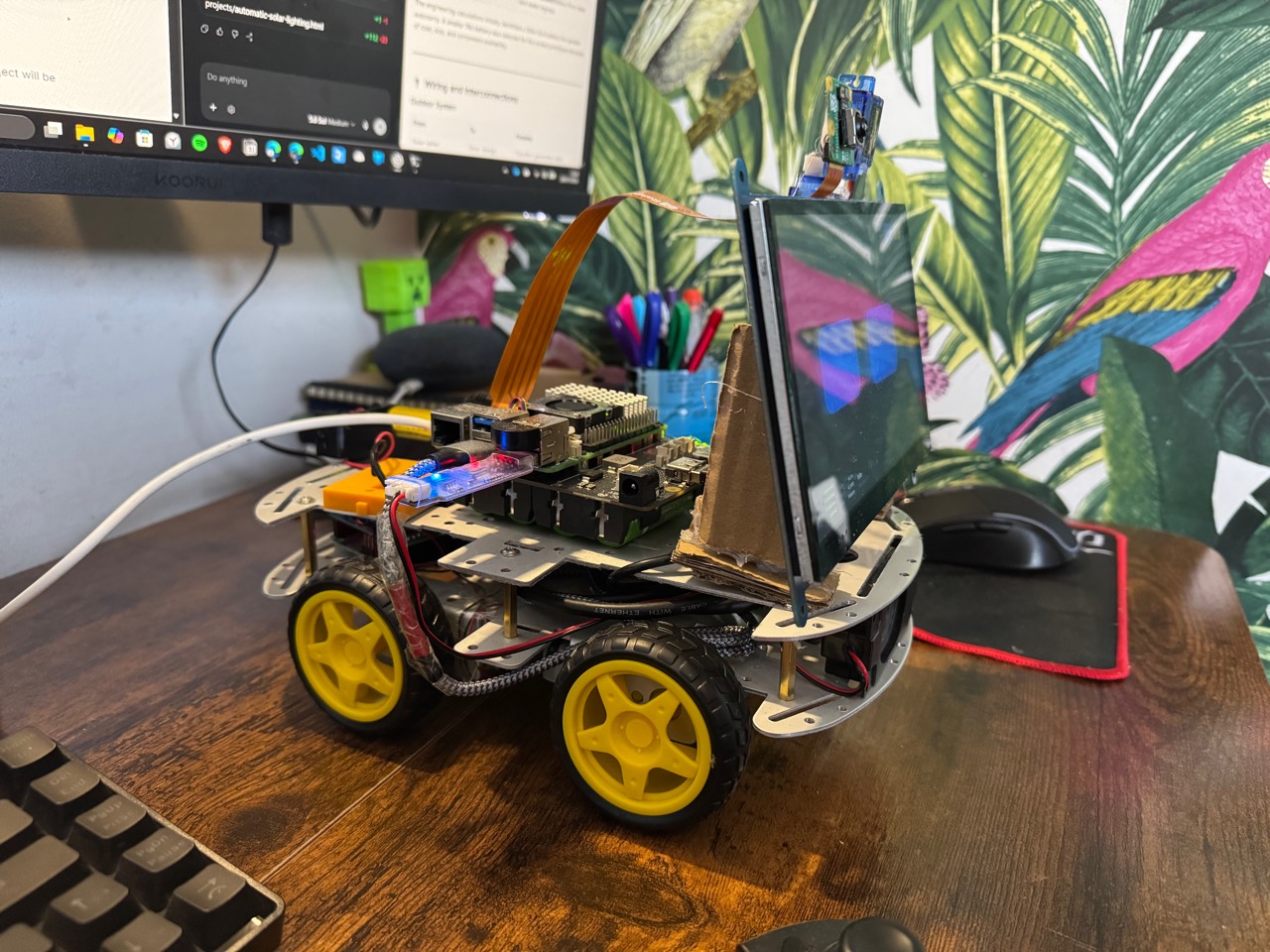
Bob is an ongoing AI-powered mobile rover that combines a Raspberry Pi, Arduino motor control, computer vision, voice interaction, an animated robot face, and a custom browser dashboard in one modular robotics platform.
I started Bob as a hands-on way to explore how embedded electronics, software, artificial intelligence, and physical hardware can work together. Rather than building only a remote-controlled car or a screen-based chatbot, my goal is to create a robot that can move, see, listen, speak, respond conversationally, and gradually develop a recognisable personality.
Current status: Functional prototype under active development.
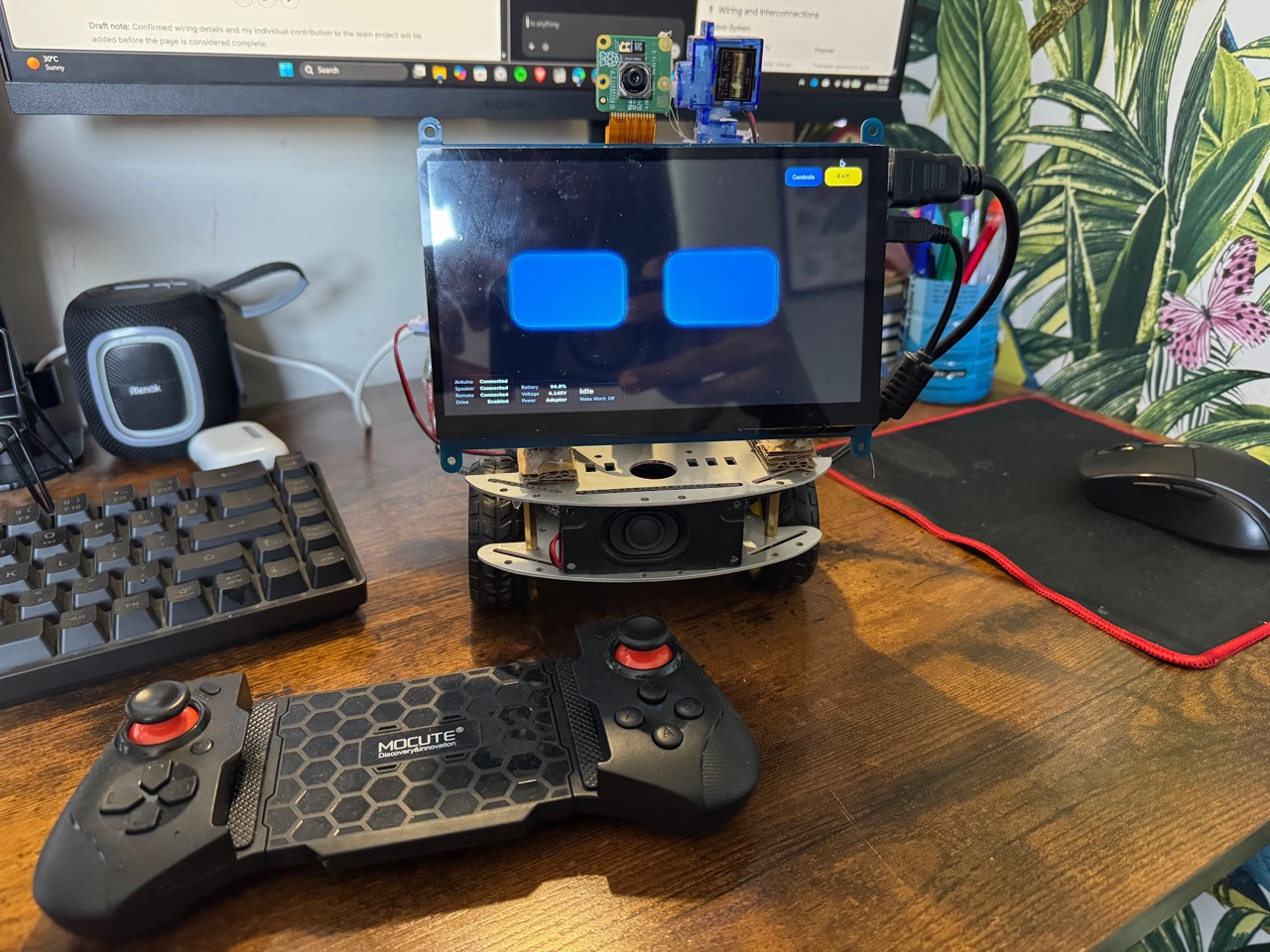
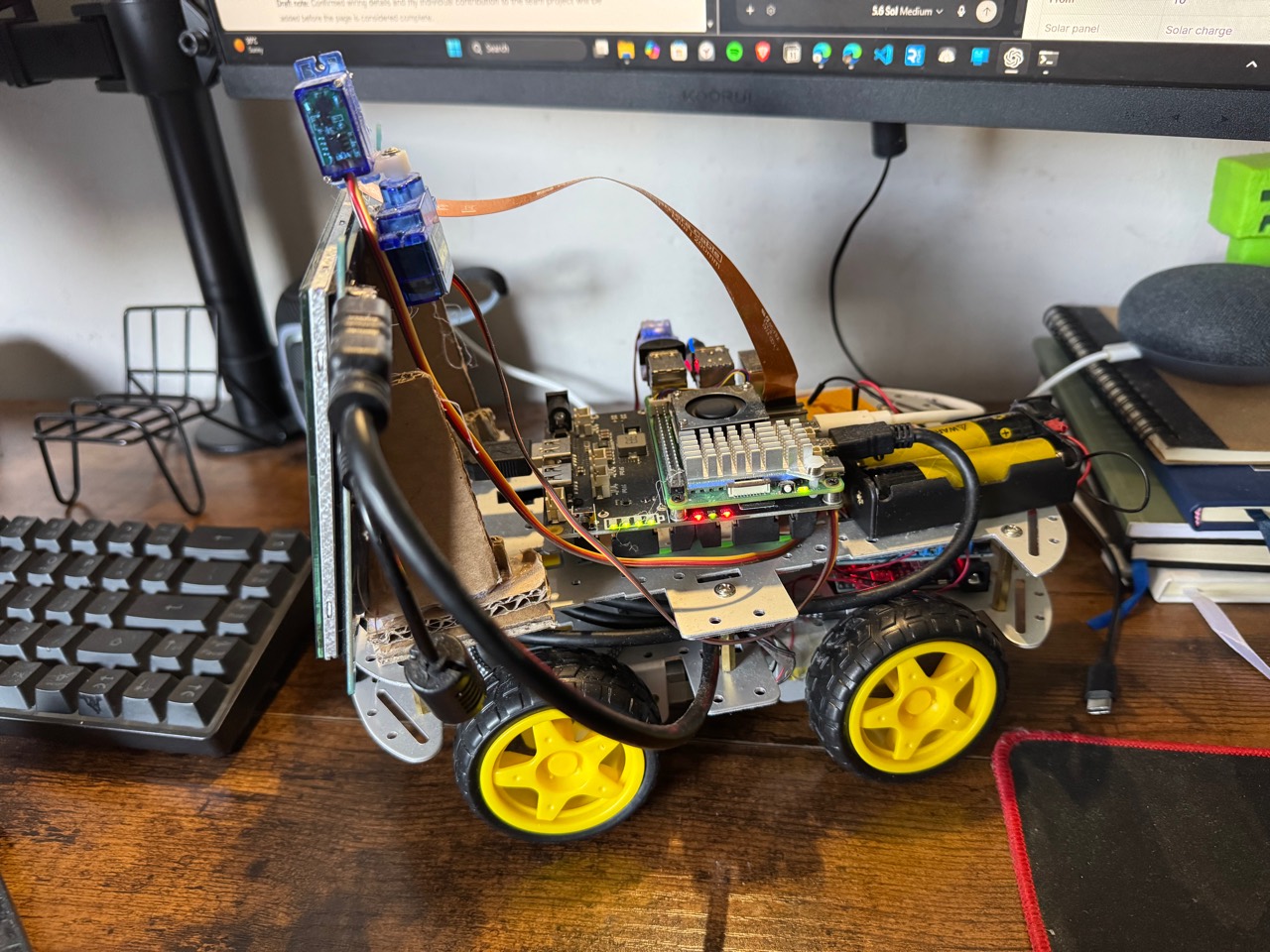
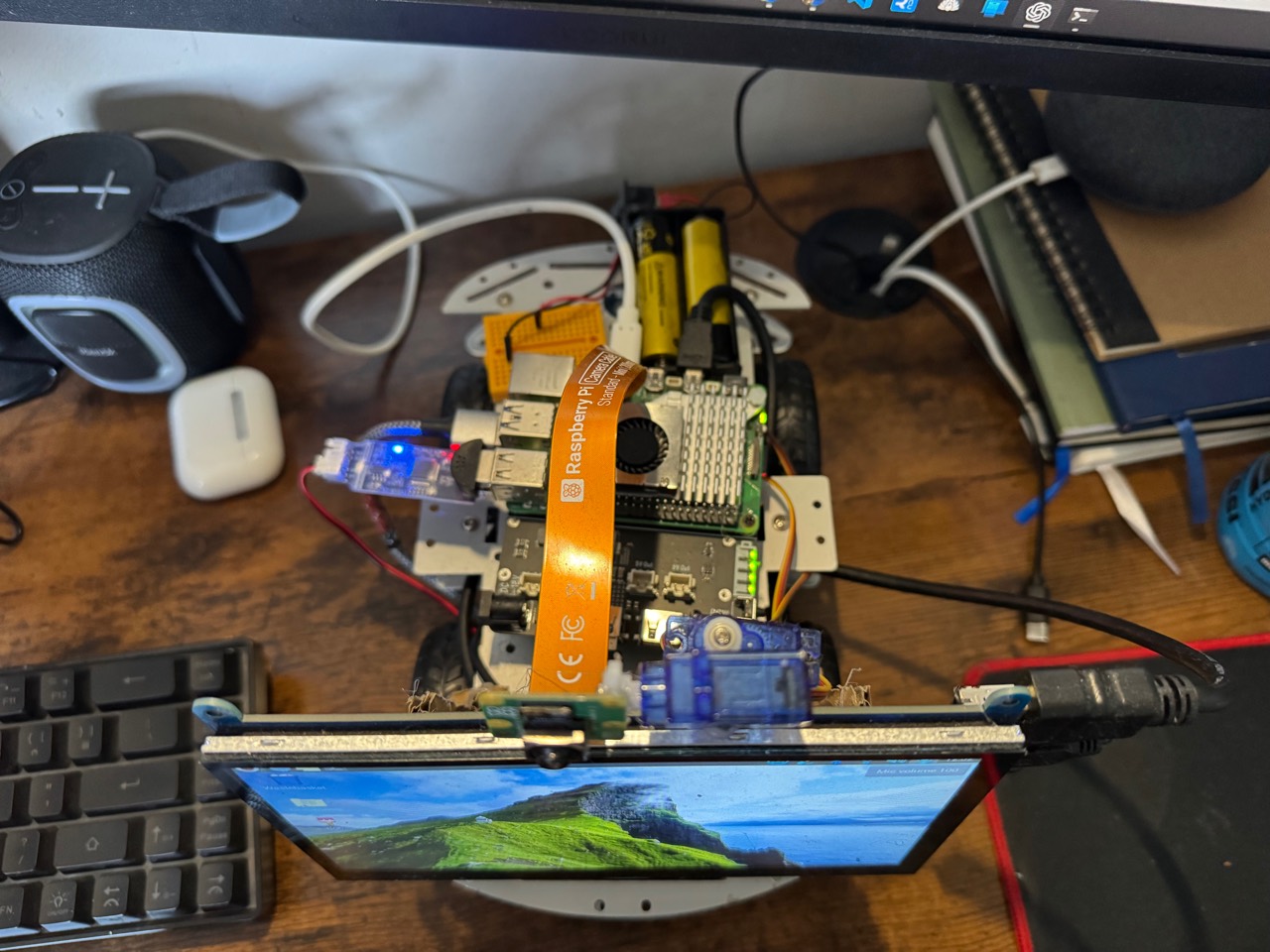
📸 Preview
🎯 Project Vision
Bob is designed as a practical robotics and embedded-systems learning platform rather than a finished consumer robot. Its modular design lets me improve individual systems without rebuilding the entire rover.
- Move around using direct dashboard or controller commands.
- Stream video and react to camera input.
- Recognise a custom "Hey Bob" wake word.
- Accept typed or spoken questions and instructions.
- Reply using conversational AI and local text-to-speech.
- Show expressions and status through an animated face.
- Progress toward safer autonomous movement and obstacle awareness.
⚙️ How Bob Works
Bob separates high-level intelligence from direct hardware control. The Raspberry Pi handles the dashboard, camera, audio, AI, and command validation. An Arduino-compatible controller handles the motors and pan-and-tilt servos through a small serial protocol.
Browser, microphone, wake word, or remote message
  -> Raspberry Pi dashboard and deterministic command parser
  -> conversational request OR allow-listed robot command
  -> OpenClaw with local Ollama fallback for conversation
  -> Piper text-to-speech for spoken responses
  -> bounded serial command for Arduino-controlled movement
Conversational model output is never trusted as a direct motor command. Physical actions must pass through deterministic application logic before a short allow-listed command is sent to the Arduino.
✅ Current Working Features
| Feature | Current Capability |
|---|---|
| Rover movement | Forward, backward, pivot left, pivot right, stop, and five speed levels through an Arduino serial protocol |
| Motor safety | Explicit stop command and a one-second Arduino motor inactivity failsafe |
| Dashboard | Authenticated Flask interface for status, movement, camera, chat, and robot controls |
| Conversational AI | OpenClaw is the primary route, with local Ollama retained as a fallback |
| Speech | USB microphone capture, speech recognition, local Piper text-to-speech, and browser speech fallback |
| Camera | Lazy Picamera2 capture with OpenCV overlays, motion processing, and dashboard streaming |
| Robot face | Browser-rendered vector face with expressions, gaze, listening, thinking, speaking, and sleep states |
| Power monitoring | UPS integration detects its I2C fuel-gauge interface |
🚧 Implemented but Not Fully Active
- The Arduino serial device was disconnected during the latest repository audit, so physical driving was not re-verified at that time.
- Camera and vision support was enabled, but the stream was idle during the audit.
- The custom wake-word system was installed but switched off.
- Game-controller support was configured, but no controller was connected and runtime control was disabled.
- End-to-end speech latency varies with network conditions and assistant response time.
🧰 Main Hardware
| Component | Role | Status |
|---|---|---|
| Raspberry Pi 5 | Dashboard, AI, camera, speech, power monitoring, and serial communication | Confirmed |
| Arduino-compatible AVR board | Bounded motor and servo control | Working role confirmed; exact installed board still being verified |
| Four DC motors and rover chassis | Physical movement | Confirmed |
| Motor Shield V1-compatible driver | Controls four motor channels using the AFMotor API | Software interface confirmed; exact hardware revision being verified |
| Raspberry Pi Camera Module 3 | Video, motion, and vision input | Confirmed |
| Pan-and-tilt servo mount | Moves the camera horizontally and vertically | Confirmed with ongoing reliability work |
| USB microphone and speaker | Voice input and spoken responses | Confirmed |
| 7-inch HDMI touchscreen | Local dashboard and robot-face display | Confirmed |
| 20,000 mAh power bank and UPS arrangement | Portable Raspberry Pi power | Used; final power architecture still being refined |
💻 Software and AI System
| Technology | Purpose |
|---|---|
| Python and Flask | Dashboard, API endpoints, hardware bridge, and system status |
| OpenClaw | Primary conversational gateway and remote integration |
| Ollama | Local conversational fallback and experimental local vision descriptions |
| Picamera2 and OpenCV | Camera capture, overlays, motion, and experimental tracking |
| SpeechRecognition | Speech-to-text with explicit remote-recognition consent |
| Piper | Local text-to-speech |
| OpenWakeWord | Custom "Hey Bob" activation experiments |
| Arduino C++ | Real-time motor and servo control |
| HTML, CSS, and JavaScript | Dashboard and animated robot-face interfaces |
🎤 Voice and "Hey Bob"
The latest audited wake-word configuration uses a custom OpenWakeWord model with thresholding, cooldown control, and suppression while Bob is speaking. Test mode is deliberately non-actioning: detecting the wake word during a test cannot activate speech, AI, the camera, or the motors.
The working voice path records bounded microphone input, converts speech to text, routes the request to the assistant, cleans and limits the reply, then speaks it through a local Piper voice. Recordings, private datasets, transcripts, and trained model files are not published.
👀 Robot Face and Personality
Bob's active face is rendered in a browser and served by the dashboard. It supports idle, awake, listening, thinking, speaking, confused, happy, searching, startled, bored, and sleeping states. Gaze values are clamped to a safe range, temporary expressions return to neutral, and the display enters a sleep presentation after inactivity.
The face is more than decoration: it makes Bob's internal state easier to understand while giving the rover a recognisable personality.
🚗 Motor and Camera Protocol
| Command | Action |
|---|---|
F | Move forward |
B | Move backward |
L / R | Pivot left or right |
S | Stop immediately |
Q / E | Move camera pan angle |
U / D | Move camera tilt angle |
C | Centre the camera |
V1 to V5 | Select one of five movement speeds |
🔬 Experimental and Planned Features
- More reliable custom wake-word evaluation in Bob's real acoustic environment.
- Local speech recognition to reduce reliance on external services.
- Improved object detection, face tracking, and vision-language descriptions.
- Ultrasonic sensing and cautious obstacle avoidance.
- Safer autonomous navigation with clear manual override boundaries.
- A more robust power-distribution and battery-monitoring system.
- Improved event-driven coordination between voice, face, camera, and movement.
- Accessibility and kiosk-mode improvements for the local display.
⚠️ Safety and Privacy
- Motor tests begin with the wheels raised and an independent power disconnect within reach.
- Natural-language output cannot send arbitrary serial bytes or unbounded movement durations.
- Camera, movement, serial, and administrative controls remain authenticated and private.
- Voice recordings, conversations, biometric images, credentials, and private network information are excluded from the public reference material.
- The source repository remains private while licensing, dashboard credentials, exact wiring, and hardware details receive a final review.
📝 Notes
- Bob is a functional prototype, not a finished autonomous robot.
- Some reference firmware improvements have compiled successfully but have not yet been flashed to the live rover.
- Older standalone speech, camera, wake-word, and face experiments are treated as historical work rather than current supported paths.
- This page will be updated as more hardware is confirmed and new features move from experimental to working.